Overhead Lines: Temperature & Load Assessment
Combine DTS temperature with operating data for thermal and load assessment. OPGW temperature is not conductor temperature; a thermal-coupling model must be established and validated.
POWER GRID / FIBER SENSING
Monitoring tasks for transmission, substations, cables and tunnels based on temperature, strain and vibration.
01 / SENSING TECHNOLOGIES
Technologies differ in fiber type, reach, attenuation, sampling speed and interrogation equipment. Reusing communication fibers requires available cores and compatible systems.
02 / APPLICATIONS
Combine DTS temperature with operating data for thermal and load assessment. OPGW temperature is not conductor temperature; a thermal-coupling model must be established and validated.
Use Brillouin strain and DAS vibration to detect anomalies. Ice thickness and tower condition require structural models, calibration and reference sensors.
Associate temperature anomalies and vibration events with line sections, supported by video or inspections. Fiber placement and heat-transfer conditions determine detection coverage.
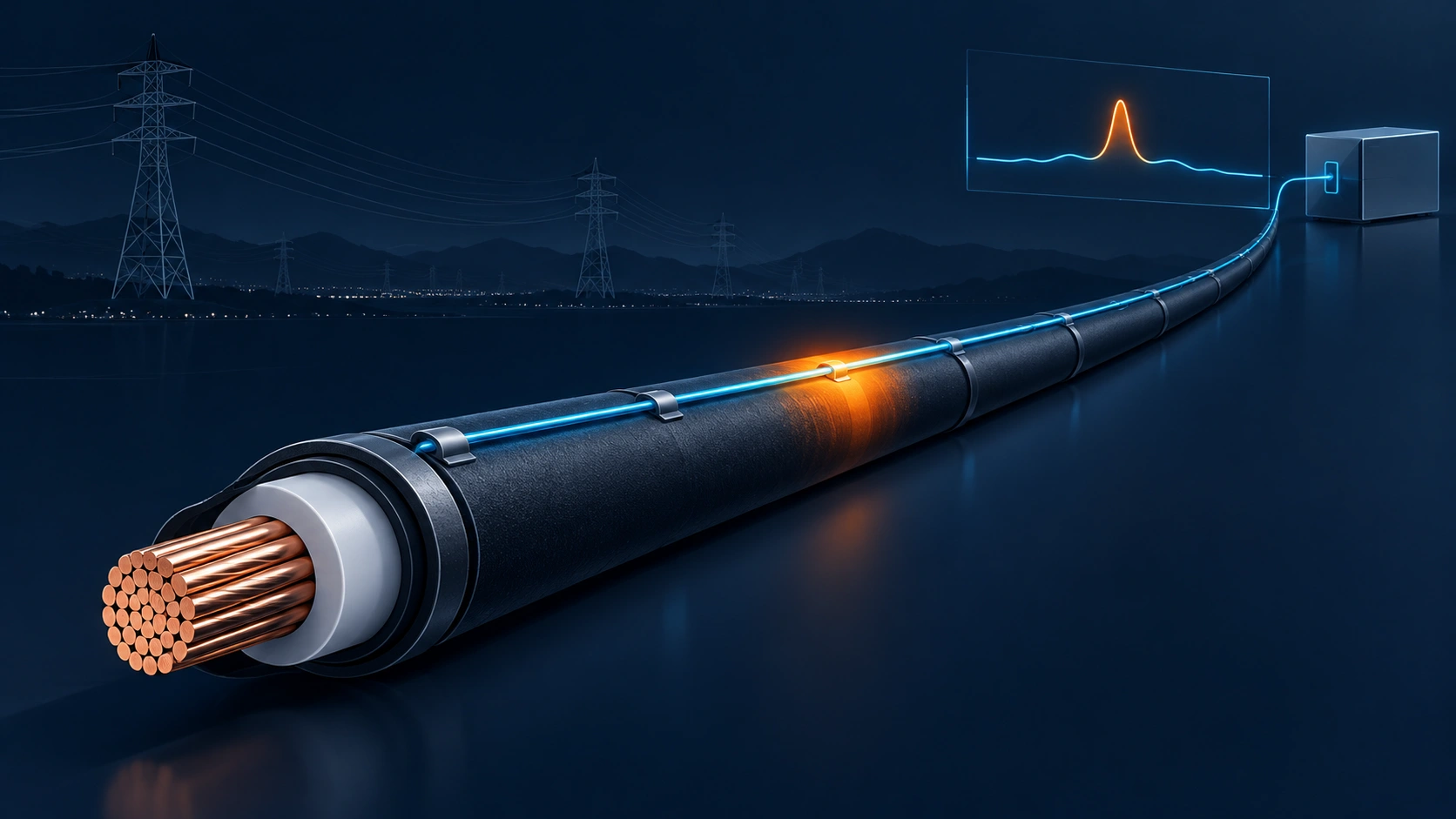
Track cable and joint heating, external disturbances and settlement-related deformation for section alerts and trend records.
Study temperature, strain and external disturbances according to cable structure and installation, with defined reach, location and attenuation constraints.
Develop monitoring for transformer hot spots, GIS partial discharge and switchgear heating, selecting probes or fiber solutions for installation and bandwidth requirements.
03 / ENGINEERING
Identify fiber cores, splices, attenuation, routing and priority risk sections.
Collect normal and anomalous data in representative sections to build event samples.
Assess location accuracy, false and missed alarms, temperature–strain decoupling and stability; integrate with alert work orders.
SOLUTION / TARGETS
Route sensing fiber along the cable sheath, including joints, bends and thermally critical sections.
Combine event location, duration and video to prioritize inspection.
Relate temperature trends to current, environment and cable thermal models.
SOLUTION / CONFIGURATION
| Monitoring task | System configuration | Outputs |
|---|---|---|
| Temperature | DTS interrogator + cable-mounted fiber | Temperature, hotspot location and rate of change |
| Vibration | DAS interrogator + mechanically coupled fiber | Event location, vibration features and timing |
| Deformation | BOTDR / BOTDA + temperature compensation | Section strain and long-term trends |
| Data platform | Edge gateway + alarm/work-order interfaces | Route map, trends and event records |
Configure sensing and integration components for the selected site and monitoring task.
SOLUTION / DELIVERY
Record cable construction, fiber cores, splice losses and critical joints.
Confirm mounting and thermal coupling; map fiber distance to route position.
Validate temperature, location and alarms using reference probes and controlled events.
Connect load and environmental data to confirmation, dispatch and retesting.
SOLUTION / EVALUATION
Reference error, location error, spatial resolution and update interval.
Measure detection, missed events, false alarms and latency by event class.
Availability, fiber-break location, splice loss and recovery time.
Route length, cable type, available fiber cores, critical joints and load-data interfaces.
BD@zhongkeyaoguang.com ↗CONTACT
Contact us for product selection, development
and project collaboration.
266 Fangzheng Avenue, High-tech Park, Liangjiang New Area, Chongqing, China
Zhongke Yaoguang (Chongqing) Optoelectronics Technology Co., Ltd.